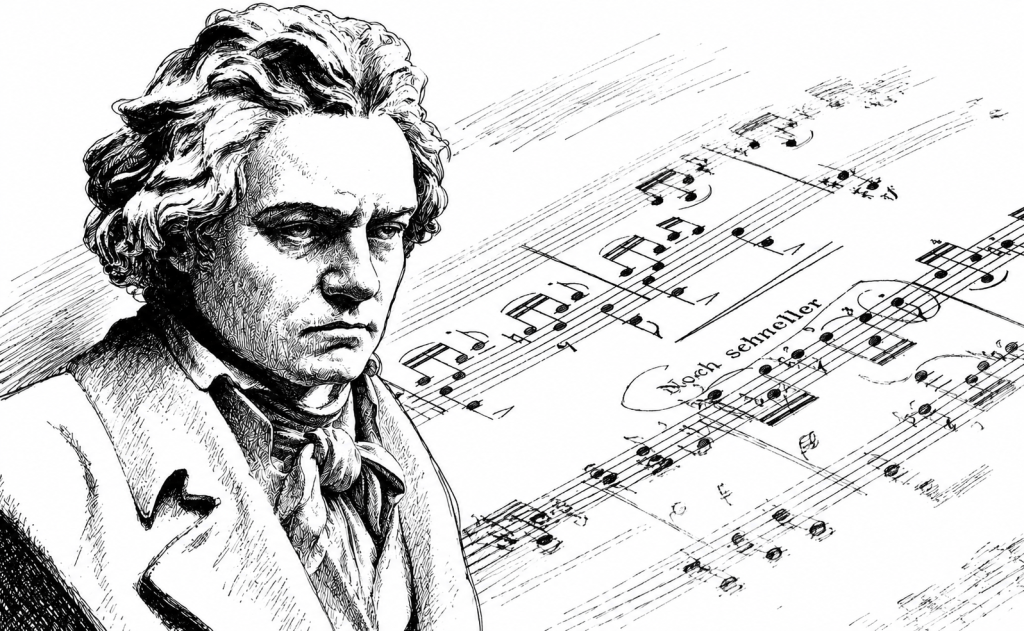
Beethoven and the Anthem of a Continent 🇪🇺
This morning brought the last music lesson of the season at my local opera house. It was a fitting end. The series had added two special sessions to the regular Sunday programme on the history of music — one devoted to Tchaikovsky, and today, the final one, to Beethoven.
We all carry some version of Beethoven inside us. We know the broad outline of his life — the deafness, the defiance, the sheer implausible scale of what he produced. We know the Ninth Symphony as the anthem of the European Union, that soaring, unmistakable melody. And yet, when the story is told again well, in a room with people who love music, it moves you just the same.


A Life Lived in Sound, Then in Silence
Beethoven’s relationship with music was, from the beginning, one of almost desperate intimacy. He composed not as craftsmen compose — cleanly, professionally — but as someone for whom music was the only adequate language for what he needed to say. The Pastoral Symphony (No. 6) is perhaps the clearest evidence of this. It is said he wrote it because he loved to walk through the Austrian countryside, through forests and along streams, listening to the world.
I understand that instinct completely. I grew up not far from Austria, where the woods and the seasons have their own deep grammar. Years later, living in the United States, it was the Pastoral that brought me back — the cuckoo calls, the rustle of leaves in summer light, the sense of something vast and unhurried in the natural world. Beethoven somehow caught all of that and held it in music. When I was far from home, he gave it back to me.




Then there is the Eroica (No. 3) — a symphony that speaks to something different, something harder. It begins in fury and grief and works its way, painfully, toward something that resembles dignity. Beethoven originally dedicated it to Napoleon, before tearing the dedication out when Napoleon declared himself Emperor. The heroism he wanted to celebrate, it turned out, had to be something more than a single man’s ambition. It had to be the human capacity to endure, and to rise.
The Night He Could Not Hear
By the time Beethoven completed his Ninth Symphony, he had been almost completely deaf for years. The work had only two rehearsals before its premiere on the evening of 7 May 1824, at the Theater am Kärntnertor in Vienna.
The situation onstage that night was extraordinary. The official conductor, Michael Umlauf, had quietly instructed the orchestra and singers to ignore Beethoven entirely and follow his baton instead. Beethoven stood before the musicians he could not hear, turning pages, marking time — throwing himself, by one account, “back and forth like a madman,” crouching and stretching, as though he wanted to play every instrument and sing every part himself. He was conducting a symphony that existed, for him, only in his mind.
When it ended, the audience erupted. Five standing ovations, it is said. And Beethoven stood with his back to the hall, still conducting, still in his own soundless world, until the young contralto Caroline Unger — twenty years old, one of the soloists he had handpicked himself — walked over and gently turned him to face the crowd.
He saw the applause he could not hear. And that image — a man receiving the recognition of the world through the eyes alone, having given that world one of the most transcendent things it would ever have — has never lost its power.

What the Music Says
The Ninth is unlike anything that came before it. It was the first symphony to bring voices into what had always been a purely instrumental form — four soloists, a full chorus, the text of Friedrich Schiller’s great poem *An die Freude*, “Ode to Joy.” The final movement builds and builds until the baritone steps forward and sings, famously, “O Freunde, nicht diese Töne!” — *O friends, not these sounds!* — as if calling the whole orchestra back from darkness toward something luminous.
Schiller’s poem is a vision of universal brotherhood, of joy as a force that dissolves the barriers between human beings. Beethoven had carried the idea of setting it to music for decades before he finally did. It was, in some sense, the destination his whole life had been moving toward.
The Anthem Europe Chose
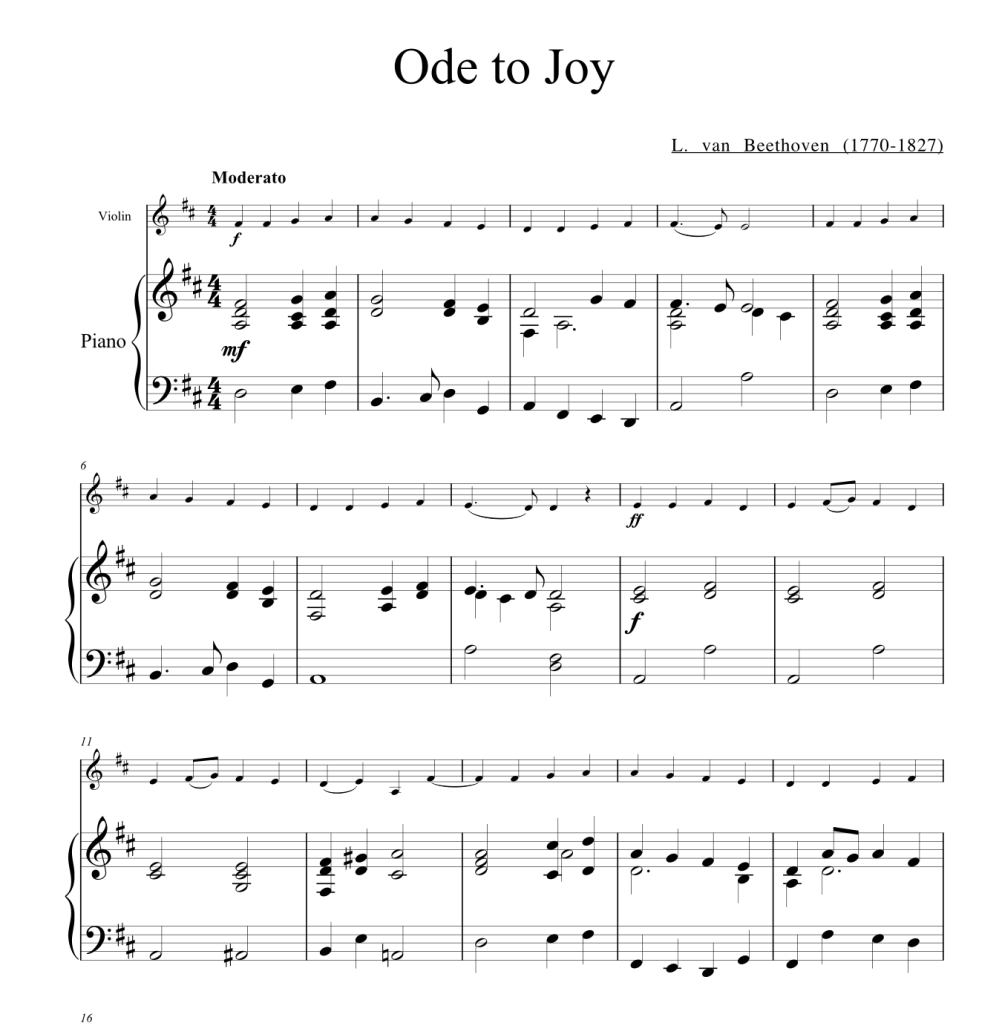
In 1972, the Council of Europe formally adopted the prelude of the Ode to Joy as the European Anthem. In 1985, the European Union made it official. Crucially, the decision was made to use Beethoven’s melody without Schiller’s German words — so that the music would belong to everyone, in the universal language that needs no translation.
It was not an arbitrary choice. The EU is a project built on a specific historical memory: the knowledge of what Europe became when its nations turned against each other, and the determination that it would not happen again. To choose as its anthem a piece about human brotherhood — written by a composer who refused to be defeated by the loss of the very sense he needed most — was to say something precise about what Europe was trying to be.
That is not nothing. That is, in fact, everything.

A Thought for Those Who Would Dismiss It
Europe has been called irrelevant by voices in the current American administration. It has been spoken of as a burden, a bureaucracy, a relic. This is not just discourteous. It is ignorant of history.
The European Union was built on the ruins of catastrophe, by people who had lived through it and were determined to construct something that would hold. It has held. It has expanded. It has been tested — by financial crises, by pandemic, by war on its eastern border — and it has not broken. The member nations disagree, sometimes bitterly, and keep talking. That is not weakness. That is civilization working as intended.
Europe has its anthem. It has its memory. It has its resolve.
And it has Beethoven — who stood in the dark and could not hear the music, and kept conducting anyway.





 Between the Lines
Leave a comment