I lived in Washington long enough to know the difference between the myth and the reality. I travelled widely, worked alongside people from every corner of the world, and felt fortunate for the range of humanity that came my way.
But it was in America that I witnessed something I did not find so easily elsewhere — a generosity of spirit that was not performative, a genuine conviction that possibilities were real, that dreams were not the privilege of the few. If you put your mind to it, something could happen. That belief was in the air. And alongside it, something quieter but equally rare: the honesty and devotion of people who had chosen public service as a calling, and meant it.
The Gap Between the People and the Policy
Americans are not always popular abroad. Vietnam is still in many memories. Military bases on foreign soil cast long shadows. Conspiracy narratives fill the rest — the kind that feel sophisticated, like seeing through the propaganda, but are simply a different propaganda. “It is America waging the war, not Russia invading Ukraine.” The people who say this with certainty have usually never set foot there.
What they miss is something that doesn’t make headlines: the culture of mutual aid, the encouragement given to strangers with ideas, the instinct to help a neighbor without being asked. That America exists alongside the other one. It always has. Reducing a people to their government’s foreign policy is a convenient shortcut that tells you very little about either.
Johnson — The Wrong Man in the Right Moment
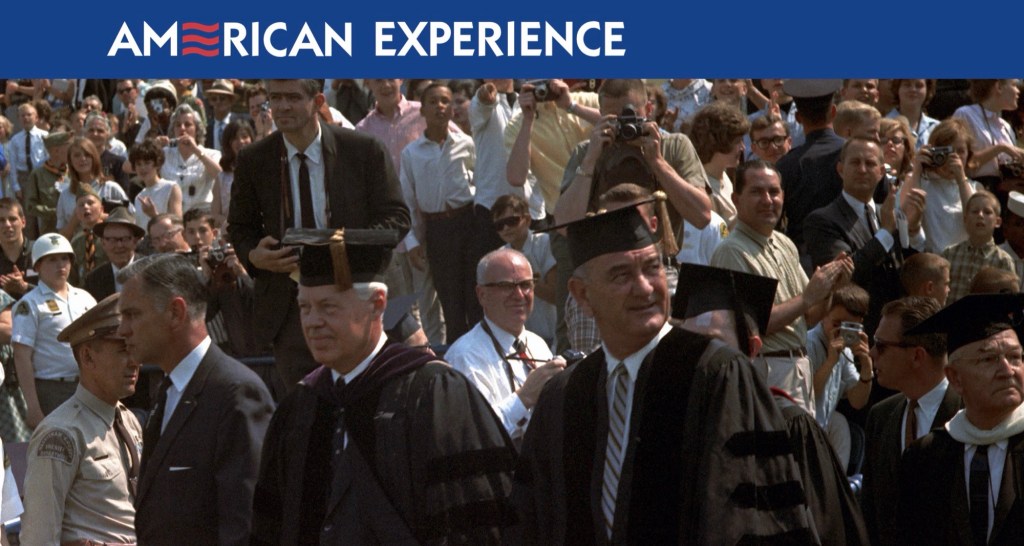
Six months after Dallas, with Kennedy’s ghost still in the room — at the very podium he had inherited — President Lyndon Johnson stood before 85,000 people at Michigan Stadium on a sunny May morning in 1964 and delivered one of the most visionary speeches in American political history. It was his first visit to the University of Michigan as a sitting president. Kennedy had originally been invited to speak.
Johnson was a backroom operator, not a television president. He did not have the glamour, the ease, the photogenic grace that history had already begun to build into myth. He had been thrust into impossibly large shoes, and everyone knew it, including him. And yet he delivered this speech — unforgettable in its ambition, precise in its humanity.
He called it the Great Society. Not a country that merely accumulated wealth, but one that used its prosperity to “enrich and elevate our national life.” A society that would demand an end to poverty and racial injustice — but would not stop there.

What the Speech Actually Said
His words still carry weight, 62 years later:
“The Great Society is a place where every child can find knowledge to enrich his mind and to enlarge his talents. It is a place where leisure is a welcome chance to build and reflect, not a feared cause of boredom and restlessness. It is a place where the city of man serves not only the needs of the body and the demands of commerce but the desire for beauty and the hunger for community. It is a place where men are more concerned with the quality of their goals than the quantity of their goods.
But most of all, the Great Society is not a safe harbor, a resting place, a final objective, a finished work. It is a challenge constantly renewed, beckoning us toward a destiny where the meaning of our lives matches the marvelous products of our labor.”
Cities, countryside, classrooms. And something rarer still in a politician: the admission that government did not have all the answers — paired with the commitment to find them together, by assembling the broadest knowledge, the best minds, from everywhere. That intellectual humility now feels almost unimaginable.
The Grief
What is being dismantled today is not just policy. It is aspiration itself — the idea that a society should want to become something more than it is. Something better. The deliberate demolition of that idea is a particular kind of violence, quiet but lasting.
Those who feel it most sharply may be those who loved America from the outside — not with the uncritical adoration of myth, nor the reflexive contempt of those who never looked closely — but with the clear eyes of people who lived there, worked there, and saw both its failures and its rare, genuine qualities. That love is not naive. Which is precisely why the loss is so hard to bear.
The Vision Outlasts the Man
Johnson was consumed by Vietnam. The war that he inherited and could not escape destroyed his presidency and shadowed everything he had built. The Great Society speech survived him anyway. It survived the war. It has survived sixty-two years.
The question now is whether the vision it articulates — that a society is measured not by its wealth but by what it does with it, not by its power but by the quality of its ambitions — can survive what we are watching today.
I am not certain it can. That uncertainty is new. And it is not a comfortable place to be.









Leave a Reply