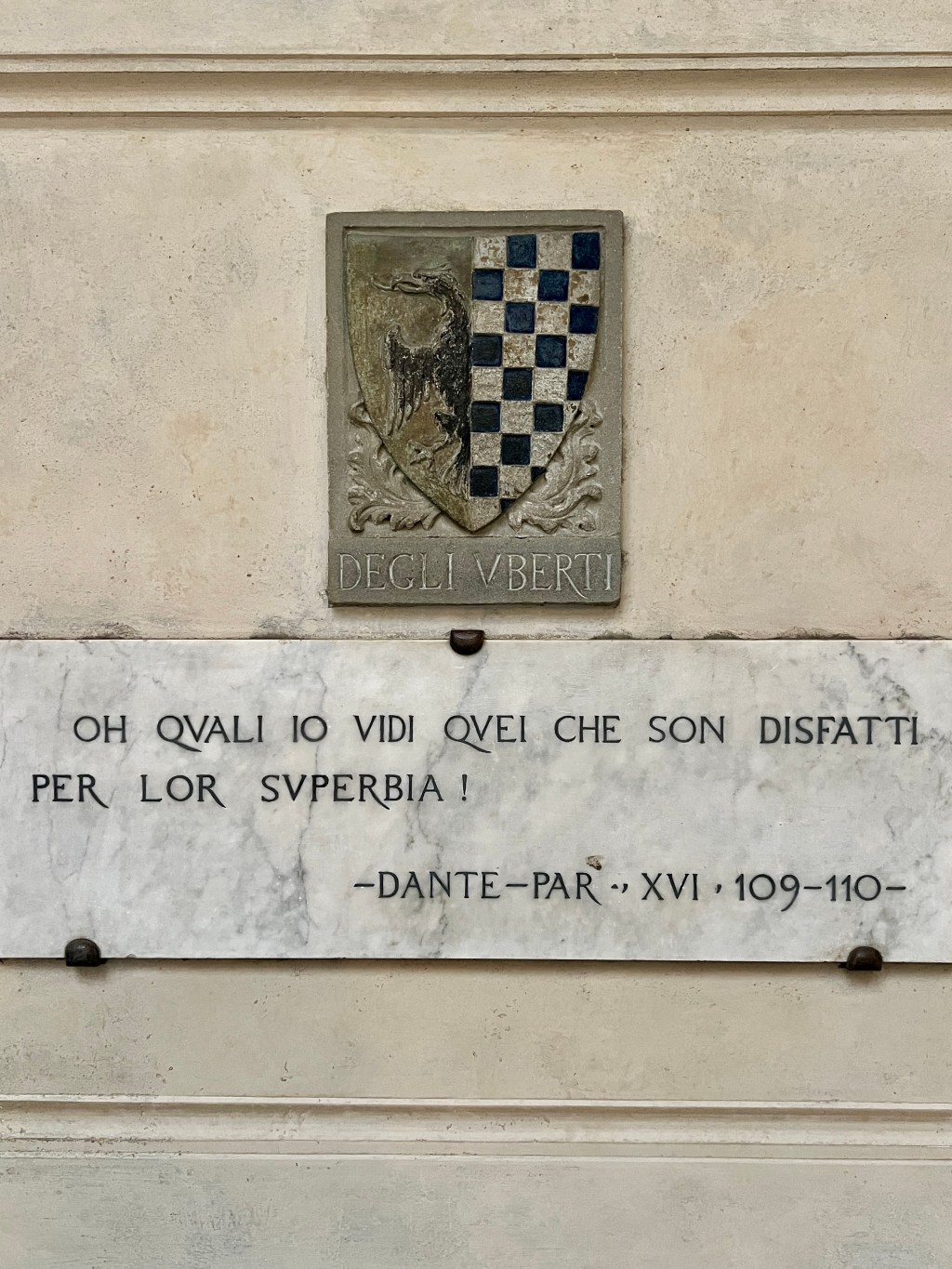
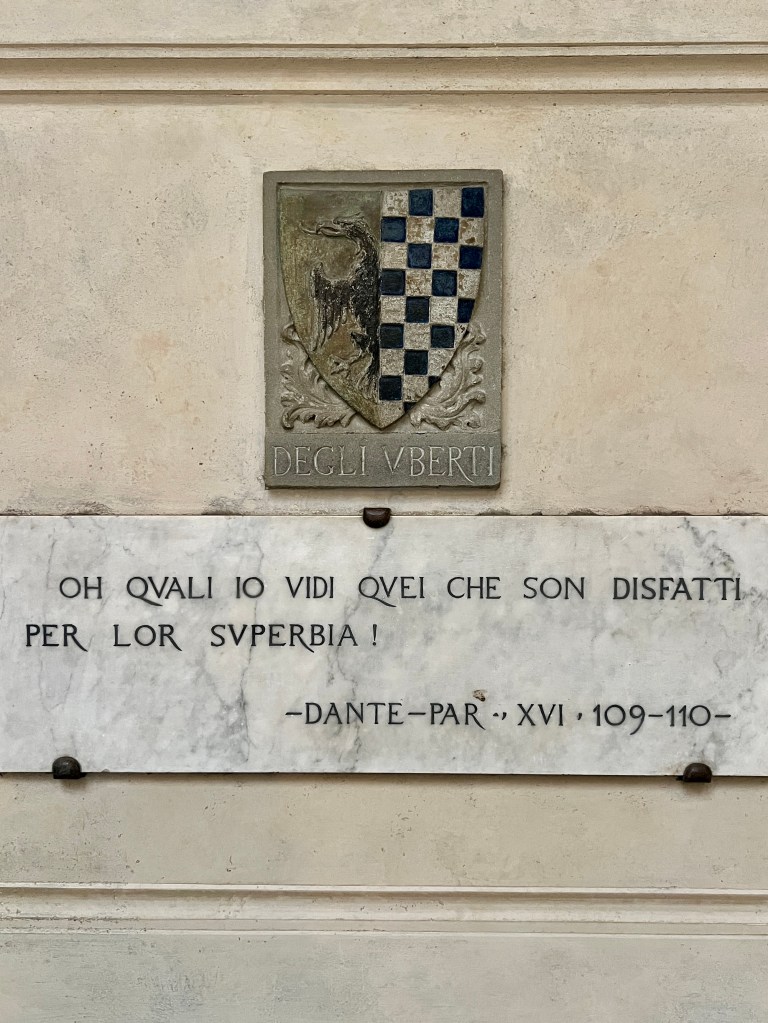
It is plaque displayed at Palazzo Vecchio in Florence.
The plaque shows the coat of arms of the Ubèrti family, one of the most powerful and notorious aristocratic families in medieval Florence.
The inscription is a quotation from Dante
“Oh quali io vidi quei che son disfatti per lor superbia!” (“Oh how I saw those ruined by their pride!”)
Paradiso, Canto XVI, lines 109–110:
That is a poignant line from Dante—and it isn’t there just for decoration. That plaque in the Cortile di Michelozzo inside Palazzo Vecchio.
Why is the plaque there—and who placed it?
It is in fact a poetic anchor to place and history.
This inscription refers explicitly to the noble Uberti family, a Ghibelline dynasty that was dramatically destroyed by their own pride and subsequently exiled from Florence. Dante places their punishing fate in Paradiso as a moral lesson on the perils of arrogance.
The site itself–Palazzo Vecchio–speaks volumes
At the beginning of the 20th century, Florence initiated an ambitious project to install numerous plaques quoting passages from the Divine Comedy in precisely those locations mentioned by Dante—creating a poetic tour of the city. Experts carefully selected quotes tied to specific sites across Florence. The plaque I saw is one of these, deliberately placed in the first courtyard of Palazzo Vecchio to mark the Ubertis’ downfall as Dante envisioned it.
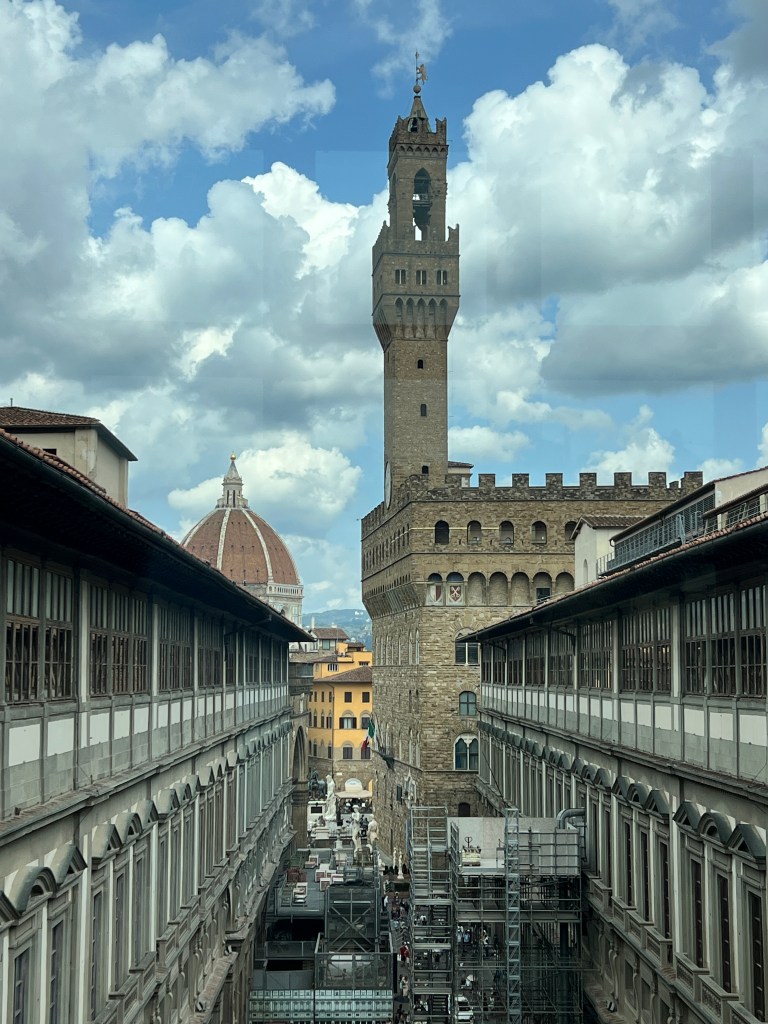
The Uberti family once owned tower-houses where Palazzo Vecchio now stands. After their exile, those towers were demolished by the victorious Guelphs. In the aftermath, the civic palace was erected directly on the ashes of the power they once held, symbolizing a groundbreaking shift in Florence’s political landscape.
A deliberate commemorative program
Who were the Ubèrti?
The Ubèrti were old nobles of Florence, staunch Ghibellines (the imperial party, aligned with the Holy Roman Emperor against the Papacy and the Guelfs). Their leader, Farìnata degli Ubèrti, was one of Dante’s most memorable characters. In the Inferno (Canto X), Dante meets him among the heretics, standing tall in his flaming tomb, still defiant.
Farìnata was infamous for his superbia—pride and arrogance. He was decisive in the Battle of Montaperti (1260), where the Ghibellines crushed the Guelfs and even considered razing Florence to the ground. Later, when the Guelfs took over, the Ubèrti were exiled permanently; their palaces were destroyed, and their family was politically ruined. Dante is pointing to them as an example of those destroyed by their arrogance. So, he was both Dante’s mortal enemy and, paradoxically, Florence’s savior.
The Dante context
In Paradiso XVI, Dante is speaking with his ancestor Cacciaguida, who laments the decline of Florence’s old noble families. He lists many that fell from greatness through vice, corruption, or pride. That’s where this line comes in: Dante is basically saying,
“I saw how those mighty nobles—like the Ubèrti—were brought low by their pride.”
Dante Alighieri
Florence likes to immortalize Dante’s words as a moral lesson. Here, the Ubèrti’s coat of arms is displayed almost as a warning: once they were powerful, now they are remembered chiefly as a case study in superbia punished.
The Ubèrti family, once lords of Florence, ruined by arrogance and political hubris. Even the mighty can be brought low, and history has a long memory.
A mix of scorn and respect?
Dante meets Farìnata among the Epicurean heretics, trapped in fiery tombs for denying the immortality of the soul.
Dante’s placement of him in Hell is a condemnation of both his politics (Ghibelline leader) and his theology (Epicurean).
Farìnata speaks with unshaken pride, even in damnation:
“Io fui sol colà dove sofferto fu per ciascun di tòrre via Fiorenza…” (I stood alone when all agreed to raze Florence).
Dante’s Paradiso, Canto XVI
His bearing is erect, dignified, unbowed by Hell’s torment. Dante paints him like a tragic statue, not a groveling sinner.
Dante may hate Farìnata’s faction, but he admires the man’s courage to stand alone against his allies to save Florence. In a way, Farìnata embodies the virtù (manly strength, civic greatness) that Dante believes Florence lacks in his own day.
As a Florentine patriot, he loathes Farìnata’s role in destroying the Guelphs. As a poet, he recognizes the grandeur of his enemy’s soul — that Roman gravitas, that civic devotion. As a Christian, he must condemn him. But as a man, he cannot help but admire him.
It’s a rare case where Dante allows an adversary to remain impressive even in Hell. So the “fascinating tension” is Dante revealing something about himself: His moral clarity (heretics belong in Hell). His political bitterness (Farìnata the Ghibelline enemy). But also his poetic honesty: he cannot deny greatness, even in those he despised.
That grudging admiration is what makes the Commedia so human — Dante damns, but he also recognizes nobility wherever he sees it.
Dante was a White Guelf (Guelfo Bianco). That little adjective White is the key to why he ended up an exile wandering Italy instead of finishing his life in Florence.
Ghibellines: supported the Holy Roman Emperor.
Guelfs: supported the Papacy
After decades of bloody factional fighting, the Guelfs finally won in Florence (1266, at Benevento). The Ghibellines were exiled, which is why Farìnata appears as Dante’s great adversary. But then the Guelfs split. Victory didn’t bring peace. The Guelfs divided into two bitter camps:
Black Guelfs (Neri): hardline pro-Pope, allied with the powerful banking families.
White Guelfs (Bianchi): more moderate, suspicious of papal interference in Florence’s civic affairs.Dante belonged here.
The split came to a head when Pope Boniface VIII meddled aggressively in Florentine politics, backing the Blacks.
In 1300, Dante was elected one of Florence’s priors (a short-term governing council). He sided with the Whites, trying to curb papal influence. He even took measures against both extremes, exiling leaders from both factions temporarily. This angered Boniface VIII and the Blacks, who saw him as an enemy.
In 1301, Boniface invited Charles of Valois (brother of the French king) into Florence as a “peacemaker.” The Blacks used this opportunity to stage a coup. They took control of Florence, sacked the city, and condemned the Whites.
Dante’s condemnation
While Dante was away on an embassy to Rome (ironically negotiating with the Pope), the Blacks seized power. He was charged with corruption, graft, and political crimes—trumped-up charges designed to eliminate him.
In January 1302 he was sentenced to pay a fine; when he didn’t (likely couldn’t), he was condemned to death by burning if he returned. Dante refused to humble himself and beg the Black-controlled government for pardon. Offers of amnesty came later—but only if he confessed guilt. His pride and sense of justice wouldn’t allow it. So he wandered: Verona, Mantova, Lucca, and finally Ravenna, where he died in 1321.
Dante, the White Guelf patriot, is exiled not by his enemies (the Ghibellines), but by his own faction’s cousins, the Black Guelfs. That bitterness runs all through the Commedia: he damns Boniface VIII before the pope even dies, and he skewers Florence as corrupt, greedy, and self-destroying.
He was banned because Florentine politics devoured itself—faction within faction, papal meddling, and Dante’s refusal to bend. He became a victim of the same civic chaos he lamented in his poetry.
Boniface VIII is one of Dante’s favorite punching bags in the Commedia, though interestingly, Dante never actually meets him in Hell (since Boniface was still alive when Dante wrote the Inferno). Instead, Dante does something even sharper: he anticipates his damnation while Boniface is still sitting on the papal throne.
Dante and Virgil descend into the Inferno, where corrupt popes who sold church offices are punished. They’re stuck head-first in holes in the rock, with their legs kicking in flames.
Dante encounters Pope Nicholas III, who mistakes Dante for Boniface. Nicholas, writhing in his hole, says:
“Are you already standing there, Boniface? Are you so quickly sated with the riches for which you did not fear to take by guile the lovely lady and then rend her apart?”
Inferno XIX, 52–55, loosely translated
The “lovely lady” here is the Church, which Boniface is accused of corrupting for worldly gain.
Dante lets Nicholas rant, thereby condemning Boniface before his death — an extraordinary move for a medieval poet. Dante essentially damns a living pope to Hell — unheard of, and dangerous, given Boniface’s power.
Boniface was behind the Black Guelf coup that exiled Dante in 1302. This is deeply personal. Dante saw Boniface as the embodiment of a corrupt papacy meddling in temporal power, ruining both Church and Florence.
So the Boniface episode in Inferno XIX is unique: Dante doesn’t even let the man wait to die before shoving him head-first into Hell. It’s poetry as revenge, sharpened into prophecy.
Florence is dotted with many more such plaques—each telling a story about a family, a place, or an episode from Dante’s journey.
 Between the Lines
Leave a comment